Three Jobs, Three Headspaces.
No single day at BKC looks the same. Some mornings I'm behind a camera by six am, or earlier depending on the season, editing images by ten, and drafting a blog post by two. Other days I sit down with a novel chapter at eight in the morning and I'm still there at six that night, having barely moved from the chair.
The photography and writing work don't share a clock. A shoot has a beginning and ends within a couple of hours: the light changes, the shot either works or it doesn't, and by evening I'm done with that piece for the day. A chapter, or even a single article, doesn't work that way. It needs at least two rounds. I get a rough version down, walk away from it, come back and cut half of what I wrote, walk away again, then do one more pass to actually polish it. Rushing that timeline doesn't make the writing faster, it just makes it worse. So on a writing day, I have to protect two separate sittings, not one, even if the calendar only shows a single afternoon blocked off.
Design work is its own animal entirely. I spent more than a month building the BKC website, and most of that time wasn't spent designing anything in the traditional sense. It was spent teaching myself how to make Squarespace do what I already knew I wanted. Anchor links, categories that only create themselves from inside a post instead of from the settings panel, formatting that quietly carries over from wherever you copied it. None of that requires the same kind of focus a chapter needs. It requires patience of a completely different flavor: the kind where you just keep clicking around until you happen on the one setting that actually does the thing.
Client design work adds yet another timetable on top of all this, along with a kind of back-and-forth the other two disciplines don't really have. When I'm out photographing something I want to photograph, or writing something I want to write, there's no one else's approval built into the process. Book covers for other authors run on rounds instead: send a concept, wait for notes, revise, send again, wait again, until the client is happy rather than until I am. That timetable isn't mine, and it doesn't pause for a two-day writing stretch just because I'm mid-chapter. There's no protecting the second sitting on a chapter when a client needs proofs back by Friday. That's the tradeoff nobody mentions when they picture the flexible life of a freelance creative: the calendar isn't actually yours, it's shared with however many clients currently have a deadline.
There's some real overlap between the three, more than I expected when I started doing all of this under one roof. The editing eye I use on a manuscript, cutting a sentence or even a whole paragraph that isn't earning its place, is close to the eye I use culling three hundred photos down to twelve, or noticing when something on the website doesn't line up: a misaligned section, a broken link, a page I forgot to build. But overlap in skill doesn't mean overlap in schedule. Recognizing what needs to be cut is the same instinct in all three. Actually doing the cutting still takes a completely different kind of day.
The part nobody tells you about running a creative business across three disciplines is that switching between them isn't free. I can't edit a chapter well, just ten minutes after wrapping a shoot, and I can't sit down to fix a broken template five minutes after finally getting a paragraph exactly right. Each one needs a different kind of attention, and the transition between them costs something every time, even on the days when I get all three done before dinner.
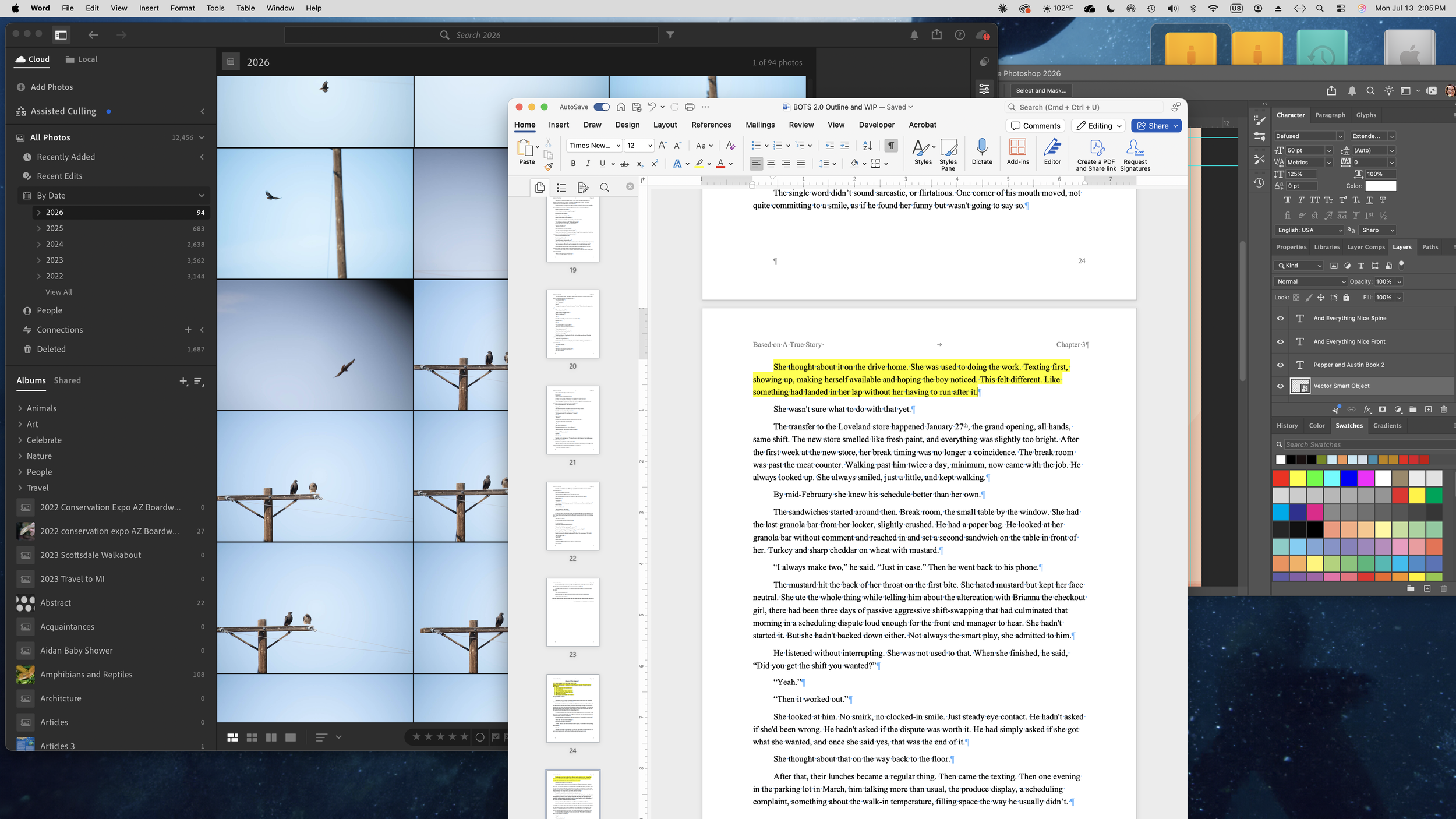
Right now my desk actually looks like this: a Word document open to Chapter 3 ofBased on a True Story, one paragraph highlighted yellow because I haven't decided yet if it survives the next pass. Behind it, ninety-four photos from a shoot earlier this year, sorted only by date, still waiting to get culled down to something usable. And behind that, a Photoshop file with two more book covers half-built, layers stacked and named, waiting on a client's notes before either one can move forward.