What a Dragonfly Taught Me About Photography
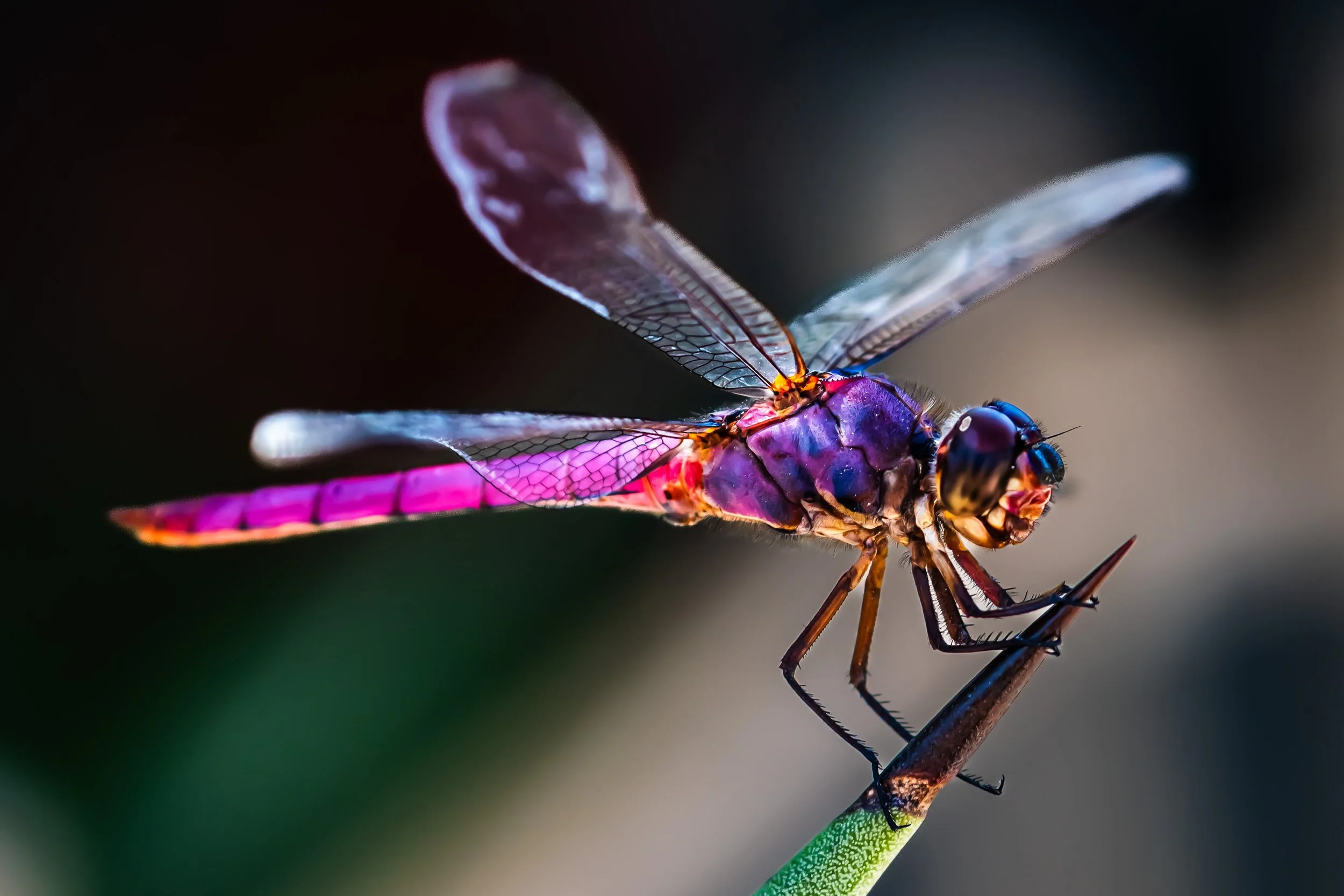
Roseate Skimmer Dragonfly perched on the tip of an agave leaf
By Ceci Ellis
Everyone assumes a dragonfly shot comes down to reflexes. Fast hands, fast shutter, right place at the right time. I believed that too, for about two weeks.
Those two weeks were humbling. I'd spot one perched on a reed, wings catching the light just right, and I'd move in for the shot, only to watch it lift off the instant I got close enough to focus. I'd find it twenty feet away, try, and lose it again. I did this for the better part of an afternoon at a pond, sweating, half-crouched, convinced the problem was my speed. I just needed to move faster, get closer quicker, beat the dragonfly to the punch.
I never caught the dragonfly. Not once.
By the fourth or fifth try, I gave up and just sat back on my heels to catch my breath. Instead of going after it again, I watched it loop around the pond, after finding my own perch by the water's edge. That's when I noticed what I'd been too busy chasing to see: dragonflies are territorial. They don't scatter at random. They patrol a stretch of water and return, again and again, to the same handful of perches. The one darting away wasn't fleeing the frame. It was just running its usual loop.
I picked an area I saw it return to several times. It was the one with the clearest sightline to the water, so I perched near it. And I waited.
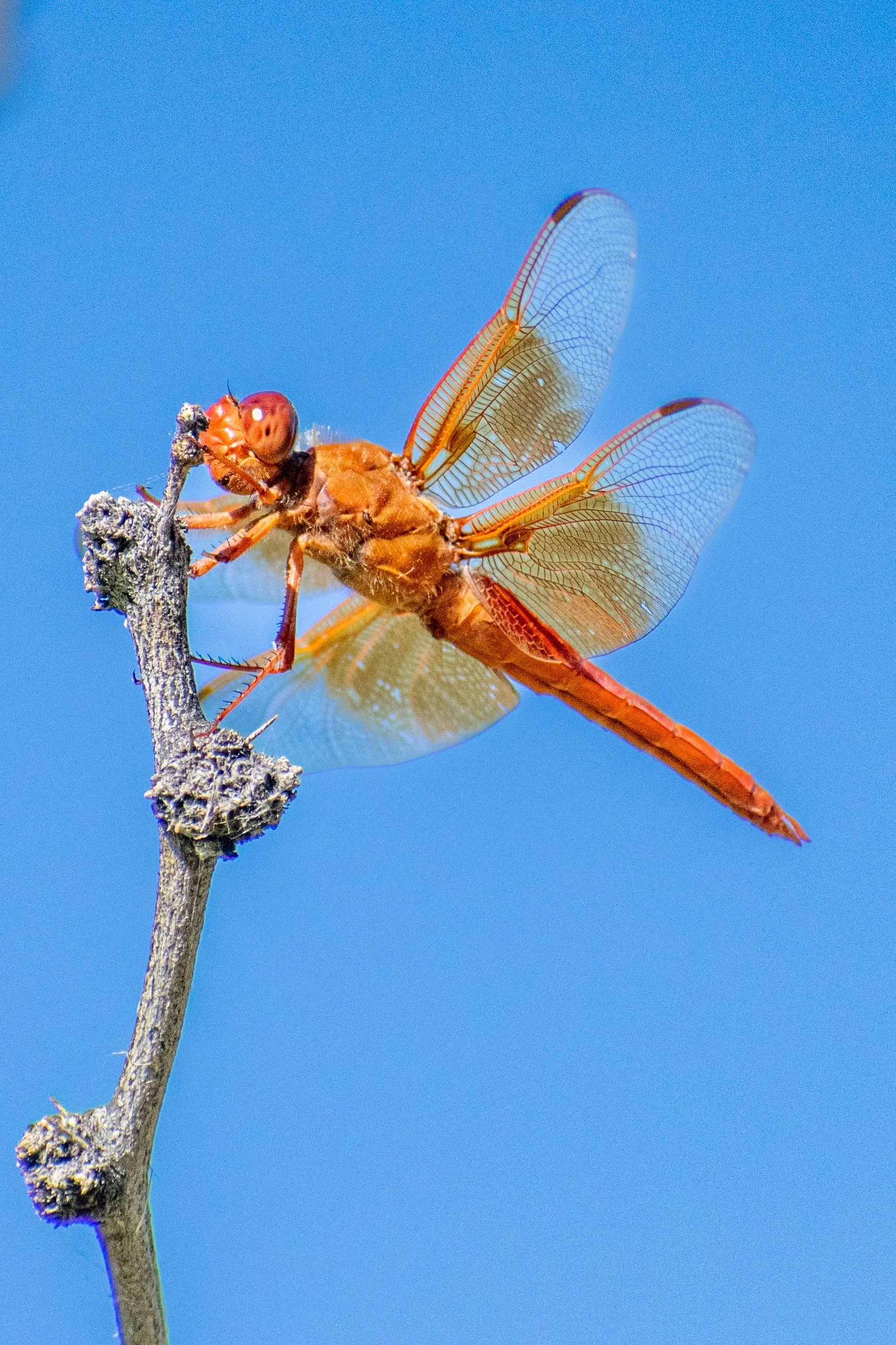
Flame Skimmer Dragonfly perched on a twig against blue sky
That's the part nobody tells you about wildlife photography: how much of it is just sitting still long enough to be part of the scenery. Ten minutes in, I stopped thinking about the shot and waited, focusing my camera on the end of a reed. Twenty minutes in, the insect chose to pose right in front of me. I had swapped to the macro lens by then, and it showed me what the long lens never could. A dragonfly’s wings weren't just transparent; they were stitched with a fine lattice of veins that caught the light differently depending on the angle. Their eyes are not just big, they have thousands of facets. It had this way of landing on the very tip of a reed stem and holding dead still except for occasionally grooming.
It came back to that perch several times in the next half hour. I got the shot on the third pass, and it wasn't even the best light of the day. But waiting patiently got me several good shots.
I think about that afternoon a lot, because it rewired something more general than just my dragonfly technique. Patience, it turns out, isn't the absence of effort. It's a different kind of effort; the work of waiting and watching long enough to understand the rhythm of an animal, instead of reacting to a single moment. That applies whether I'm photographing a bird, a pet, a child, or a product on a table that isn't moving at all. Every subject has a pattern if you give it the time to show you it.
Rush past that, and you're simply reacting. Wait for it, and you get closer to the truth of the subject.
Photography often gets sold as a game of speed — fast glass, fast reflexes, fast content. But the shots I keep coming back to are almost never the fast ones. They were the ones where I’ve sat patiently just seeing my subject, and the shutter was the last thing that happened, not the first.
So, a small, iridescent thank-you to one very patient dragonfly. Since then, I've chased several dragonflies; a blue dasher, a roseate skimmer, a flame skimmer, and the pattern holds every time. I almost always find them near water, even a puddle-sized pond barely worth the name. Different species, same rule: sit down, watch the perch, let it come back to you.
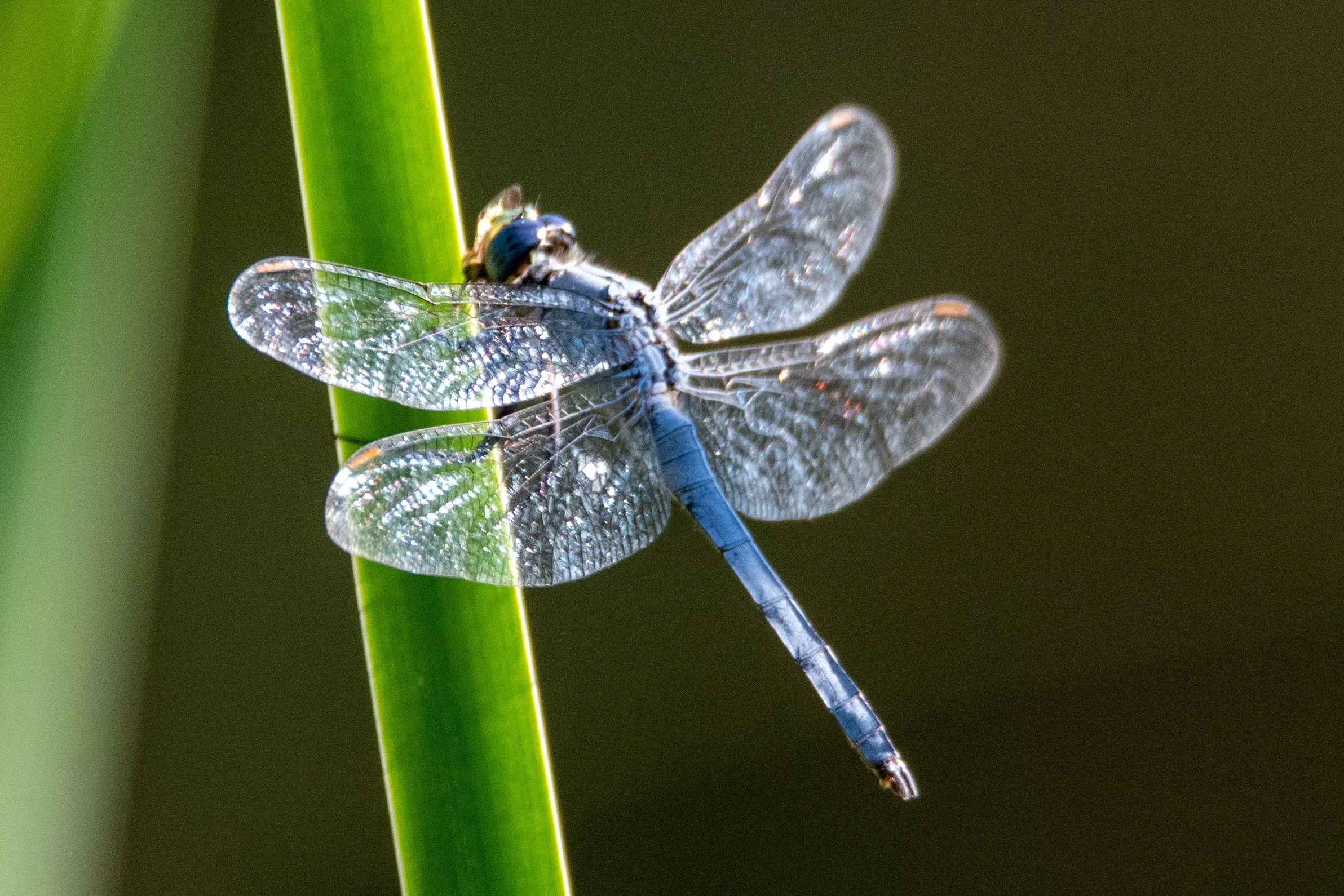
Blue Dasher Dragonfly perched on a reed.